
Advisory Engagement Proposal

For GiftKarte, a plan to be raise-ready.

Prepared for Saad Usmani & Khurram Bashir, founders of GiftKarte Technologies. The work that gets you from a business investors should notice to a raise they'll compete to join.

Prepared by Asad ur Rehman Date April 2026 Confidential For discussion
A note on posture

This is a partnership, not a consulting engagement.

I'll be in the work with you — coaching, challenging, and building alongside the team — not delivering a report and stepping away. That changes what you can expect from me week to week, and it shapes the commercial structure below.

Everything that follows is built on that frame.

What I've seen so far

The business is rare. The translation isn't ready.

GiftKarte has built something genuinely uncommon for the region: a gifting and rewards business that's profitable, has real corporate traction, and has demonstrated organic cross-border demand without meaningful marketing spend. The 220+ brand partner network and the depth of corporate relationships are the real moat. Most founders raising at this stage don't have a fraction of that foundation.

The gap isn't the business. The gap is how the business gets translated into a narrative, a product, and numbers that investors can underwrite with confidence.

My thinking has sharpened since our earlier exchange — particularly on product, where I now see meaningful opportunity to reshape the gifting experience and embed AI in ways that would materially change how investors evaluate the company. The workstreams below are structured around closing that translation gap.

The engagement

Five workstreams, one outcome.

Tap each to see where GiftKarte stands today and where we'll get to.

Today

The deck positions GiftKarte as a gift card platform serving three verticals. The TAM/SAM logic relies on broad market percentages — $22B TAM built on remittance volume with a 10–15% gifting assumption. A sophisticated investor will push back on this in the first meeting.

What we'll build

A sharper thesis that reframes GiftKarte from "gift card platform" to a defensible corridor-based business. Pressure-tested TAM and SAM methodology with citable sources. A clear corridor sequencing logic — which markets first, why, and with what evidence. Competitive framing against regional and global comparables that makes the moat explicit.
Today

The deck reports transaction volume and EBITDA — real and impressive — but doesn't show the underlying engine. No unit economics. No margin waterfall. No revenue bridge from today's $4.3M to the 2030 projection of $20M. The instrument framing — "$3M for 25% via SAFE" — also needs work: a SAFE doesn't price equity directly, it sets a cap that converts at the next priced round. The current framing either implies a $12M post-money cap (which becomes an anchor in every subsequent conversation) or signals the instrument hasn't been fully thought through.

What we'll build

An investor-grade model with unit economics per vertical, margin waterfall, cohort behaviour, and a defensible bridge to the 2030 target. A clean instrument framing with a valuation cap justified by comparables. A use-of-funds allocation that ties back to the model, not a pie chart. Everything investors will ask about, answered before they ask.

Today

The deck describes corridor ambition but no acquisition framework. How does a diaspora user in Toronto discover GiftKarte? What does it cost to acquire them? What's the payback period? For a raise built around scaling corridors and entering new markets, these are the first questions an investor asks — and they're currently unanswered.

What we'll build

A customer acquisition framework per vertical and corridor. Channel economics, CAC and payback assumptions per market, and the operational readiness needed to execute Phase 1. A growth plan that moves from "we'll market in diaspora hubs" to a specific, fundable sequence of moves.

Today

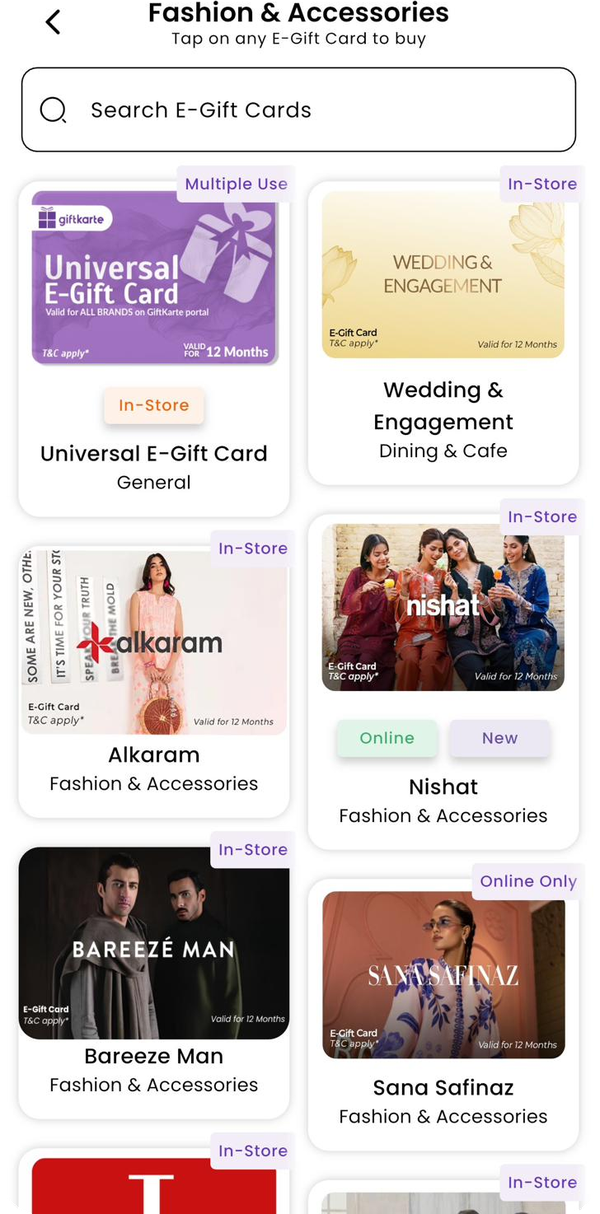
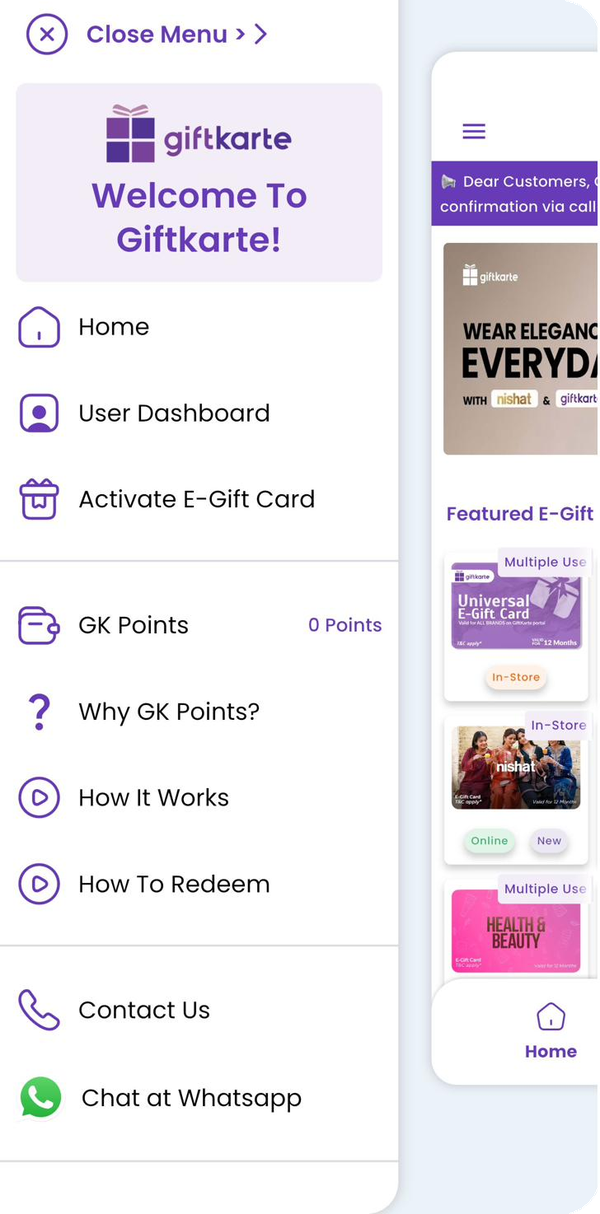
The product is structured as a gift card marketplace. The home screen leads with a fashion banner. Discovery is organised by category, brand, and city — logic borrowed from e-commerce. The user dashboard surfaces Profile, GK Points, and transaction history — functional, but built around the sender as a shopper, not around the gift as a ritual. The deck, by contrast, promises something emotionally richer: gifting as an alternative to remittances, conveyance of emotion, occasion-first.

GiftKarte home screen showing fashion banner and card grid
Home
GiftKarte side menu with utility navigation
Menu
Gift card detail view with amount selector
Card detail
What we'll build

A prototype direction that closes the gap between the deck's promise and the product's reality. Three areas of focus:

Recipient-first flow. Reframe the purchase journey around who the gift is for and why — the brand becomes a consequence of the recipient, not the starting point.

AI-embedded personalisation. Occasion intelligence, personalised message generation, recommendation logic tuned to the relationship rather than the SKU. This is where the narrative shift to "AI-native gifting platform" becomes defensible in an investor room.

Emotional conveyance in the product itself. Bespoke messaging, unwrap moments, a meaningful recipient-side experience. Today the recipient gets a code and the sender gets a receipt. The product should feel like a gift on both sides.

Today

The current deck tells the story GiftKarte wants to tell. It doesn't yet tell the story an investor needs to hear to underwrite a cheque. The difference is subtle but consequential — it's the difference between a warm response and a term sheet.

What we'll build

A rebuilt deck to institutional standard. Financial pack, executive summary, and objection-handling materials. Founder rehearsal sessions covering the hardest questions investors will ask. Once materials and strategy meet the bar, warm introductions to relevant investors from my network — made only when the package can carry its own weight.

How we'll work together

Close, disciplined, and ready to start.

Weekly working sessions of 60–90 minutes. Async access in between via WhatsApp and email — I'm genuinely available, not gated. Shared working documents so the team sees the thinking as it develops, not just the output. Founders lead; I steer, challenge, and build alongside.

Ready to begin within two weeks of signing.

Wk 1–2
Discovery
Deep-dive on financials, product, and corridor logic. Align on priorities.
Wk 3–6
Build
Financial model, positioning, product direction, AI prototype framing.
Wk 7–9
Package
Deck rebuild, financial pack, executive summary, objection handling.
Wk 10–12
Rehearse & introduce
Founder prep. Warm introductions once the package carries its own weight.
Commercial structure

Aligned, not transactional.

Engagement fee
USD 20,000 over 12 weeks
Payable in four instalments tied to phase milestones. First instalment on commencement.
Advisory equity
3%, vesting on first close of the raise
Outcome-based, not time-based. If the raise doesn't close, the equity doesn't vest.
Success fee
5% of capital raised
On capital from investors introduced or materially advanced through this engagement. Payable in cash or additional shares, at my election, at close of investment. Twelve-month tail post-engagement. Final structure to be agreed on the call.
A modest engagement fee to fund the work — with the real upside earned only if we succeed together.
Boundaries

What this engagement is not.

This engagement does not include acting as a regulated placement agent or broker-dealer, legal structuring of investment instruments, or ongoing operational management post-raise. Final investor approaches and negotiations sit with the founders. Your counsel should review the success fee structure against local regulatory requirements; I'm happy to work with them on language that's clean for both sides.

Let's talk.

A 60-minute call to walk through this together and agree on final structure. Happy to hold a slot this week.

Message on WhatsApp